

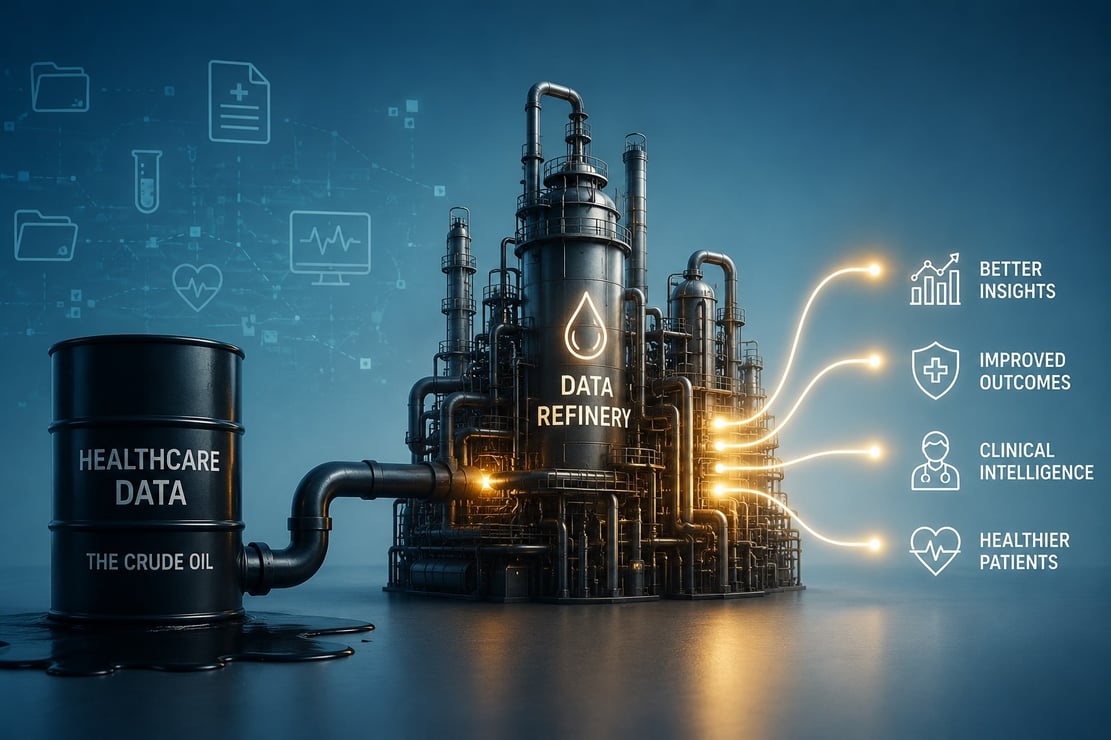
The raw material has been sitting there for decades — in EHRs, in notes, in labs, in devices nobody fully reads. What’s changing now is our ability to process it.
Ramani Narayan · July 2026 · 6 min read
When EHRs were first deployed at scale, nobody framed them as information systems. They were billing systems. Every field, every coded drop-down, every structured data point was engineered for one primary purpose: getting a claim submitted to an insurer and paid. Clinical intelligence wasn’t the goal. It wasn’t even a secondary consideration. No wonder physicians like Dr Ilana Yurkiewicz say: “There’s an unspoken assumption when you go to see a doctor: the doctor knows your medical story and is making decisions based on that story. But the reality frequently falls short.”
Physicians pushed back on EHRs almost immediately. A survey conducted around the time HITECH passed found that 96% of physicians were worried about losing what they called “the unique patient story” with the shift to point-and-click, template-driven EHRs — and 94% said the physician narrative was “important or very important” to measuring and improving patient outcomes. More than fifteen years later, the patten holds. A qualitative study published in JMIR Formative Research in March 2025 (Golburean et al., DOI: 10.2196/63902) — based on observations and interviews with physicians conducted in 2023–24 - found that physicians still default to free-text documentation even after EHR transitions, specifically because structured fields “impede expressivity” and free text allows them to record “detailed and nuanced patient narratives”. Technology has changed. The behavior hasn’t, because the underlying clinical need hasn’t. What they did, practically, was route their actual clinical thinking through the one field that didn’t have a billing taxonomy policing it: the free-text notes. It was designed as a catch-all for information that didn’t fit anywhere else. It became the place where medical reasoning got documented.
That choice — made by thousands of physicians across thousands of systems, independently, over decades — created a situation the industry is still reckoning with. The most clinically important information ended up in a place where nothing was built to read systematically; that is until the development of large language models.
The structured fields tell you what got billed. The notes tell you what the physician thought. For most of the EHR era, only one of those was searchable by a machine.
Why the Notes Became So Important
The structured fields in most EHRs are organized around diagnosis codes, medication codes, and procedure codes. These maps to billing workflows. A physician checking a box to confirm a diagnosis is doing so partly because the system needs that code to generate a claim.
Physicians adapted the way they always do when a system doesn’t fit the work: they used the only field that didn’t have a taxonomy policing it. The assessment, the clinical reasoning, the observations that didn’t map any available code — all of it ended up in the notes. Some EHR implementations added character limits to push back against this. Physicians ignored them or found ways around them.
The result, borne out now in published research, is that roughly 80% of clinically meaningful information in a patient’s EHR lives in unstructured text — in prose that no structured query can reach (JAMIA, 2026; Applied Clinical Trials, 2026). The actual reasoning, the longitudinal picture, the observations that changed a physician’s thinking — it’s all there, in language a person can read, and a database cannot.
Ask an EHR to surface every diabetic patient whose A1c has been trending for six months while their notes suggest medication adherence is slipping. The structured fields cannot answer that question. The notes could — if someone had time to read them. In a typical primary care practice, with fifteen-minute appointments and a panel of several hundred patients, no one has that time. That gap — between the information that exists and the information that can be used — is where most of the value in healthcare data is trapped.
What Flatiron Health Proved
The problem has been visible for a long time. What wasn’t available was any practical way to solve it at scale.
Flatiron Health found one answer, for oncology at least. Their model was simple in concept: if machines can’t read unstructured clinical notes with the nuance the task requires, hire people who can.
Humans in the Loop: Flatiron’s process utilized a large workforce of clinical experts — nurses and certified tumor registrars — who read through unstructured clinician notes, scanned lab reports, and pathology documents, converting them into highly structured, regulatory-grade datasets. It was painstaking, specialty-specific work. But the data it produced was something the industry had never had at scale: a clean, structured oncology dataset that pharmaceutical companies could use for research.
Roche bought Flatiron in 2018 for $1.9 billion. The dataset that justified that price came almost entirely from information that had always been in the clinical record — written by oncologists, sitting in free-text fields, never queryable by any system. The value wasn’t created by Flatiron. It was extracted.
But the model doesn’t travel. Human annotation at Flatiron’s scale is expensive and slow, and oncology has characteristics that made it unusually viable — a concentrated patient population, a defined set of conditions, pharmaceutical companies with large research budgets. You can’t replicate that approach in primary care or cardiology or pediatrics. There aren’t enough clinical annotators in existence, and the unit economics collapse well before you reach meaningful scale.
The interesting question is whether AI can do what those nurses and tumor registrars did — read the note, understand the clinical context, extract the relevant information, and code it correctly — at a cost and speed that makes the approach viable across all of medicine, not just the one corner where Flatiron operated.
Flatiron proved there was a business in extracting value from clinical notes. What they couldn’t prove was whether it could scale. That’s the question AI can now answer.
What the Refinery Actually Does
The infrastructure being built today is trying to do computationally what Flatiron’s clinical workforce did by hand.
The starting point is normalization. A patient’s records are spread across their primary care EHR, one or two specialist systems, a lab, possibly a hospital from a visit years ago — each with its own format, its own coding conventions, its own interpretation of what fields to populate. Getting all of that into a single consistent representation is the first technical task. FHIR is the industry’s answer to this, and it helps, but it only standardizes the structure. A Condition resource in FHIR can arrive coded in ICD-10, SNOMED, or a local code the sending system invented for its own purposes. All of those are valid FHIR. None of them mean the same thing to a downstream clinical query.
Ontology annotation is what adds the semantic layer. Every condition gets mapped to SNOMED, which is hierarchical — so once you’ve done that mapping, “give me all cardiovascular conditions for this patient” is a query against the hierarchy, not a list of codes someone assembled by hand. Medications map to RxNorm, and then to MED-RT, which records what each drug is for — meaning a medication prescribed for heart failure joins the cardiovascular picture even if it never appears in the patient’s condition list. Labs map to LOINC. The data stops being a collection of records and starts being something you can reason over.
Notes are where it gets genuinely hard. A clinical NLP pipeline can extract mentions of conditions, medications, symptoms — but the extraction must be sophisticated enough to understand what the physician meant, not just what they wrote based on the context. “No chest pain” and “chest pain” look similar to a keyword search. They carry opposite clinical meanings. “Father had MI” is family history, not finding for this patient. “We discussed her prior history of diabetes” is different from “diabetes, active, on metformin.” The system must capture all of those distinctions — the assertion type, the temporal context, the certainty level — and map each mention to the right ontology code.
When this runs correctly across a patient’s full record, what comes out is close to what Flatiron’s clinical experts produced by hand — a dataset where the clinical information is structured, attributed, and queryable regardless of whether it came from a coded field or a note written a decade ago.
What Gets Unlocked
The most immediate beneficiary is the physician in the exam room. A patient with diabetes, hypertension, CKD, and three specialists involved has a clinical history spread across multiple systems and dozens of notes. The physician has twelve minutes and no way to read all of it. They work from whatever they can pull up quickly, and they miss things — not through inattention, but because the task exceeds what any person can reliably do under that kind of time pressure.
When the record is properly annotated and the systems are connected, the physician opens the chart and the relevant picture is already assembled — active conditions, medications with their indications, labs trending in the right or wrong direction, the endocrinologist’s note and the cardiologist’s note already cross-referenced. None of that information is new. It was in the chart. It just wasn’t accessible in that form before.
Zoom out from the individual encounter and the same infrastructure does different things. Clinical trial enrollment that used to require months of manual chart review becomes a structured query. Quality reporting that depended on someone reading notes to verify findings can be automated. Population health programs can identify at-risk patients before they show up in the ED. Pharmaceutical researchers get access to real-world evidence from across medicine, not just the specialties where someone happened to build a Flatiron.
And that’s before you get to the data types that haven’t been incorporated yet — genomics, continuous monitoring from wearables, device output from MRI machines that most hospitals capture only a fraction of. The annotated clinical record being built now is the foundation those streams will eventually join. They’re not a separate problem. They’re the next layer.
Who Wins When the Refinery Works
The EHR vendors aren’t going anywhere. A system of record that took decades to build, that carries legal and regulatory weight, that physicians and administrators have organized their workflows around — that doesn’t get replaced by a startup, however well-funded. What changes is the layer on top of it.
The relationship isn’t competitive. An EHR whose data can be normalized, annotated, and queried by clinical meaning is more valuable to every physician using it. The layer being built on top doesn’t threaten the system of record — it makes the system of record worth more.
For physicians, the payoff is direct: time. The hours spent reconstructing patient histories from fragments — physicians using this kind of infrastructure consistently report recovering somewhere between 60 and 90 minutes a day — go back to the patients. Not because an AI is doing the clinical thinking, but because the information assembly work that was falling on the physician now has somewhere else to go.
The patient side is less immediately visible but probably more important. Clinical care quality is not evenly distributed. A patient seen at a well-resourced academic medical center by a specialist with time and institutional support has a different experience than a patient at an independent practice where one physician is managing a large panel with limited access to specialist input. This infrastructure doesn’t erase that gap. But a physician working with a fully assembled, coherent patient record is better positioned to catch what matters than one working from fragments — wherever they practice. That difference is felt most acutely by the patients who most need it to.
None of this comes online overnight. The work starts with the clinical record — normalizing it, annotating it, making it queryable — and expands from there. Devices, genomics, real-world evidence at scale. Each layer adds to what was already built. What the system ends up with, eventually, is something it has never had before: a coherent, complete picture of its patients that can be queried, shared, and acted on.
Flatiron made a version of that argument for one disease area, built it with nurses and tumor registrars reading notes by hand, and sold for nearly two billion dollars. The scale of what’s being attempted now is different — all of medicine, all specialties, automated rather than manual. But the underlying claim is the same: there is enormous value sitting in healthcare data that nobody has been able to use.
The infrastructure being built today is what makes it usable. That infrastructure is what ThetaRho is building. We normalize patient records across EHRs and HIEs, annotate them with clinical ontologies, extract meaning from unstructured notes, and expose the result as a liquid, queryable layer that clinical AI applications can build on. RISA, our clinical intelligence platform, runs on this foundation today.
If you’re building clinical AI and spending more time on data plumbing than on clinical logic, or if you’re a health system or practice that wants to understand what this infrastructure could mean for your physicians and your patients, we’d like to talk. Reach out at thetarho.ai or find us at linkedin.com/in/cbenara.
This post is part of The Clarity Protocol, ThetaRho’s ongoing series on AI, clinical workflow, and healthcare data. Earlier posts in this series cover the FHIR and ontology infrastructure that makes this kind of data processing possible.
ThetaRho (thetarho.ai) builds clinical AI infrastructure for healthcare organizations. RISA is our clinical intelligence platform — HIPAA-compliant, AICPA SOC certified, and live on the athenahealth Marketplace.
Leave a Reply